Amyl and the Sniffers Went Country in a Mexican Restaurant
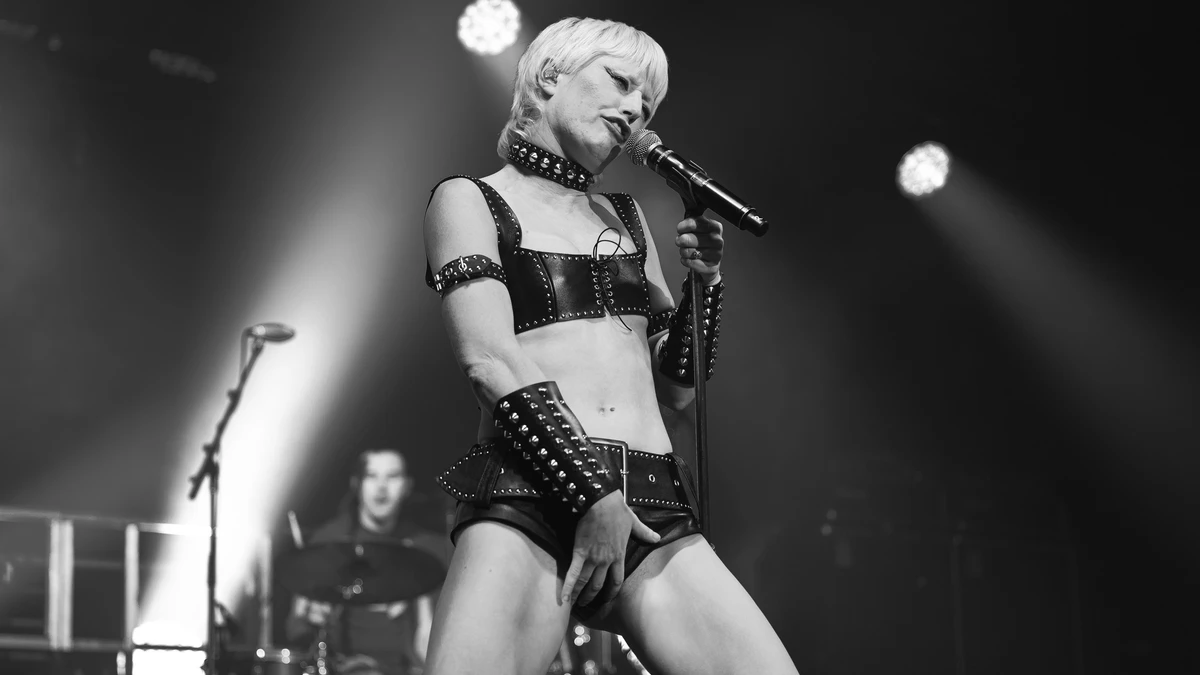
Amy Taylor performing with Amyl and the Sniffers
Most live albums exist to document a band doing the thing it already does, at a bigger venue than last time. Amyl and the Sniffers have released one that does close to the opposite.
Truth or Consequence came out on 4 September through Virgin Music Group. It is a live record and a concert film, it runs to 13 tracks, and it was recorded in a Mexican restaurant with the band’s punk catalogue rebuilt as country songs.
One Room, One Night, Thirteen Tracks
The recording took place on 28 April 2025 at El Coyote in Los Angeles, a restaurant rather than a venue, in front of what Consequence describes as an increasingly rowdy audience.
John Angus Stewart directed. He is a long-standing collaborator who previously made the band’s videos for Hertz, Guided by Angels and U Should Not Be Doing That, so the film is not an outside crew documenting a band, it is someone who has been in the room before.
The 13 tracks pull across the catalogue. Glide lists reworked versions of Big Dreams, Hertz, Jerkin’, Facts and Caltex Cowgirl, alongside two previously unreleased songs and a cover of Slim Dusty’s Lights on the Hill.
That Slim Dusty cover is the clearest statement of intent on the record. He is an Australian country institution rather than a punk reference point, and Lights on the Hill is a trucking ballad about exhaustion on a long haul. Putting it next to Jerkin’ tells you the country framing is not a costume.
Why a Punk Band Can Survive the Arrangement
Reworking a fast, loud catalogue as country is a genuine test, because it removes the two things that usually carry this kind of material: volume and tempo.
What is left is the writing. A song that only worked because it was played at speed through a cranked amplifier collapses immediately in a slow arrangement, and everyone in the room hears it collapse. There is nowhere to put the failure.
The band’s songs happen to be built to survive it. They are structured, they have choruses, and the lyrics work as plain speech rather than as sounds fitted to a rhythm. Slowed down and stripped back in a restaurant, they turn out to be songs rather than performances, which is a distinction a lot of punk records would rather not have tested.
It also helps that country and the band’s usual register share more than the genre labels suggest. Both deal in direct language, working life and complaint, and neither has much interest in being subtle about any of it.
The Room Was the Point
The label framing makes the intention explicit. Rough Trade, announcing the project, carried the band’s own description of what they wanted from it: “The hope for this record is that it is listened to as it was made, in a ruckus exclamation between a cherished group of friends.”
That sentence explains the venue choice. A restaurant has no stage separation, no barrier, no lighting rig and no acoustic treatment. The audience is at tables, close enough to be part of the recording whether or not they intend to be, which is why the crowd becoming rowdier over the course of the night is a feature of the record rather than a problem with it.
The performance was played with friends rather than as a standard set, and the film intercuts behind-the-scenes footage with the songs. The result is closer to a document of an evening than a concert release.
Two Live Records in Under a Year
The release timing is the part that shows the thinking. This is the band’s second live album in under twelve months, following Live at Ally Pally in December 2025, which captured their largest headline show, at Alexandra Palace in London.
Those two records are opposites by design. One is the big room, the full production and the peak of a touring cycle. The other is a restaurant with the songs slowed down. Releasing both inside a year gives a listener the widest possible view of what the band is, and it means neither record has to pretend to be the definitive one.
It is also a smart way to spend the gap between studio albums. A band at this stage has a catalogue that will bear reinterpretation, and a live record built on a real idea holds attention in a way that a standard tour document does not.
The Film Came First
The sequencing is worth noting because it inverts the usual order. Theatrical screenings began on 27 August at select international cinemas, with the album following on 4 September.
Putting the film first makes sense for this particular project. The premise, a punk band playing country in a restaurant, is easier to understand when you can see the room, the tables and the audience three feet from the microphone. Hearing it without that context, the arrangements would simply sound like unusually restrained versions of familiar songs.
Amyl and the Sniffers have effectively used the film to explain the album, which is the reverse of how concert films normally function.
Why a Live Record Is Worth Making Again
Live albums spent a long stretch being the least interesting release a band could make. In an era when any show is on a phone within hours and full sets sit on video platforms permanently, an official document of a gig competes with free footage of the same gig, recorded better by the venue’s own desk.
What survives that competition is a live record that could not have been assembled from any other night. This one qualifies on every count. The arrangements exist nowhere else in the catalogue, the room holds about as many people as a large bar, and the two unreleased songs are only available here.
There is a practical argument underneath the artistic one. A band between studio albums has a real problem: the catalogue is touring well, the audience is engaged, and there is nothing new to give them without rushing the next record. A reinterpretation solves it honestly. Nobody is being sold a repackage, because the songs genuinely are different.
The economics favour it too. A film with theatrical screenings, a vinyl release and a streaming album from one night in a restaurant is three products from a single day of recording, at a fraction of what a studio album costs to make. For a band whose live reputation is the asset, that is the efficient use of it.
What stops this being cynical is the difficulty. Playing your own catalogue in an unfamiliar style, in a small room, in front of people close enough to see your hands, is harder than playing it properly at a festival.
What Happens to These Songs on Tour
The band returns to North America on 1 October, opening in Dallas, with both weekends of Austin City Limits, plus Atlanta, Raleigh, Nashville and New Orleans. The European run through August took in OFF Festival, Oya and Pukkelpop.
Festival sets will not be country. The interesting question is whether any of these arrangements survive into the live show, because a band that has proved its songs work slowly has an option most punk acts do not: a change of pace mid-set that is not a gimmick, because there is now a record behind it.
Frontwoman Amy Taylor has been working outside the band as well, contributing Nobody’s Son to the Peaky Blinders: The Immortal Man soundtrack, which points in a similar direction. A voice that carries a country arrangement in a restaurant is a voice that carries a film cue.
Records built around a constraint tend to reveal what a band actually has, in the way that the Big Moon made Forever after their singer lost her hearing. Here the constraint was self-imposed and considerably more fun, but the test was the same one: take away the volume and find out whether the songs were ever the point. On the evidence of 13 tracks recorded in a restaurant, they were.